
Amazing FreeCell

Your game will start after the following advertisement.
Play Amazing FreeCell
Solvable puzzles, unlimited undo with smart hints, different game modes, and difficulty levels allow you to make the game as challenging or as relaxing as you would like.
Main features at a glance:
● Clean and neat design with a fresh and intuitive interface
● High-quality graphics with smooth animation
● Classic FreeCell Solitaire with fun and exciting game play
● Two game modes: Classic and Bakers
● Unlimited undo and redo
● Smart hints
● Easy, medium, hard, and random difficulties
● Multiple themes, card decks, and backgrounds to choose from.
Play Amazing FreeCell for free now!
How to Play Amazing FreeCell Solitaire
The goal of Amazing FreeCell Solitaire is to move all the cards to the four foundations located in the upper right corner of the board.
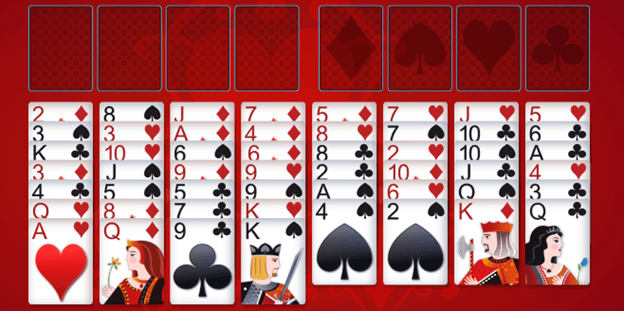
You can place cards in numerical order from the lowest (Ace) to the highest (King) card on the foundations. Each foundation must be filled with cards of the same suit. Once a card is moved to a foundation pile, it can no longer be moved.
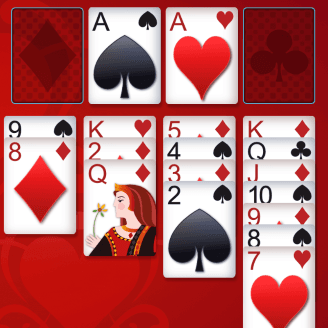
There are also four free cells located in the upper left corner of the board that you can use to hold any single card for future use. This is very useful when you want to get access to a card that is blocked by another. Simply move that blocking card to an open free cell. To open up any free cells, you will have to move cards to either a foundation pile or back to a stack of cards in a tableau below.
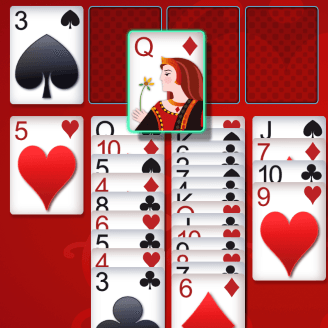
In the classic game, there are eight tableaux on which you can place cards from the highest (King) to the lowest (Ace) in alternating order by color.
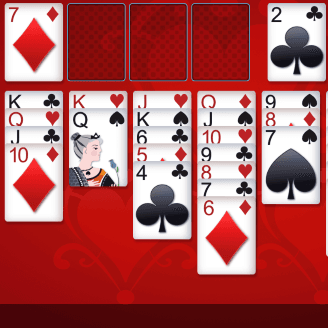
In the baker’s version of the game there are eight tableaux on which you can place cards from the highest (King) to the lowest (Ace) of the same suit and color.
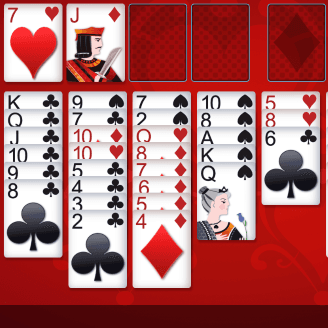
You can move any single card or pile of cards to an empty tableau, just as long as they are in the proper sequential order, and you have enough empty free spaces.
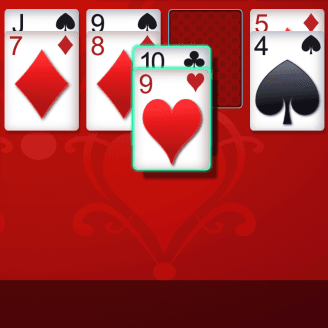
You can move as many cards or single cards at one time as there are free cells by dragging them between the piles. Single click on a card and the game will try to move it to the best possible position.
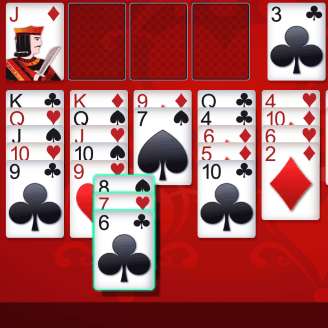
If you would like to undo or redo a move, you can do so an unlimited number of times simply by clicking on the appropriate button located on the bottom of menu.

There are more settings under the menu panel to customize your game to how you like it.
Have fun playing Amazing FreeCell Solitaire!
History of FreeCell Solitaire
FreeCell solitaire is a variant of card Solitaire that sprung from the game "Eight Off". A version of Eight Off that preceded FreeCell was called "Baker's Game", named after C. L. Baker. Baker was a mathematician who used to lead the computer science department at the Rand Corporation in the 1960s. Baker's Game was popularized by an interview Baker had with Martin Gardener, a famous author who wrote the "Mathematical Games" column for Scientific American for over 25 years. In the interview, Baker claims to have learned the game from his father who had allegedly learned it from an "Englishman in 1920".
Eventually, Baker's Game turned into modern day FreeCell by Paul Alfille, a computer scientist at the University of Illinois, in the mid-1970s. During his time at the University of Illinois, Alfille was able to program a version of Baker's Game into the PLATO computer system. Short for Programmed Logic for Automatic Teaching Operations, PLATO was one of the first educational computer systems that relied on a graphical user interface to interact with the computer. It was this graphical capability that allowed Alfille to visualize the game. However, given the small screen resolution of PLATO's gas plasma display, Alfille was limited in how many columns of cards he could display at a time. This ended up leading to the modern-day FreeCell distribution of card piles even though, in theory, the sizes of the piles and number of piles can vary.
Like Klondike Solitaire, FreeCell was popularized by inclusion in the Windows operating system. Programmer Jim Horne developed Microsoft's version of the game completely unbeknownst to Paul Alfille. Alfille was never given formal credit on Microsoft's version of the game.