
Amazing Sudoku

Your game will start after the following advertisement.
Play Amazing Sudoku
Sudoku is a timeless puzzle game involving numbered blocks with the goal simply to analyze the intersecting rows and columns and find the missing numbers to complete the puzzle.
⭐ Simple and easy interface
⭐ Hints for when you get stuck
⭐ Draft and undo moves
⭐ Check your work as you go
⭐ Timed games with multiple difficulty levels
💜Play Amazing Sudoku for Free now!💜
How to play Amazing Sudoku?
Amazing Sudoku is a puzzle game which has a square board divided into a 9x9 grid and within that smaller 3x3 blocks.
Some of the spaces are already filled in with numbers to get you started. These cannot be changed.
To solve the puzzle, you just need to fill in the remaining blank spaces with the numbers 1 to 9 making sure not to repeat any numbers within each of the 9 rows, columns, and 3x3 blocks. The provided numbers are brown and those that you fill in will be colored grey.
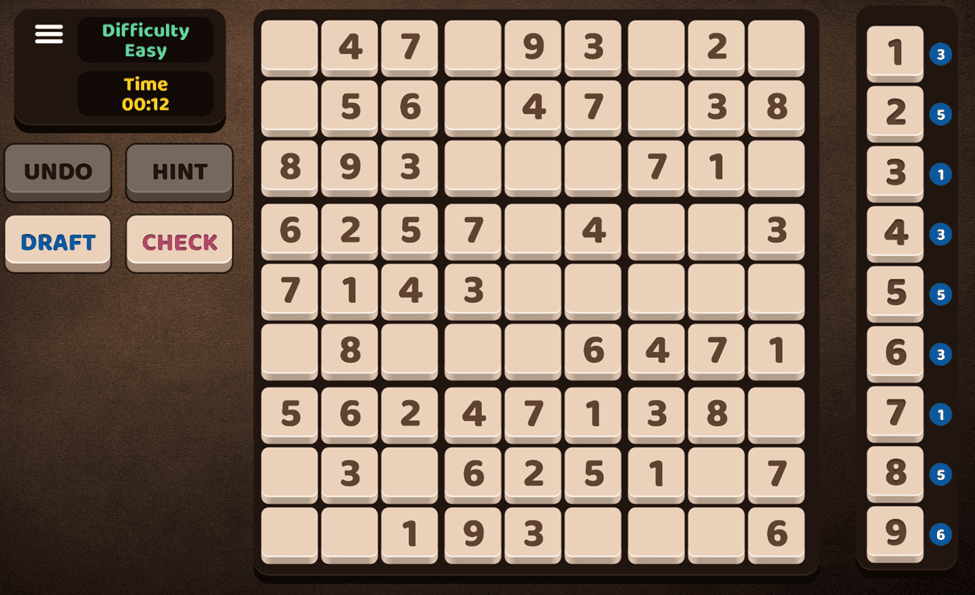
Start by selecting a space on the board that you want to fill in. To make it easier to choose a number, the corresponding row and column will be highlighted. Remember, each row and column can only contain one of a single number.
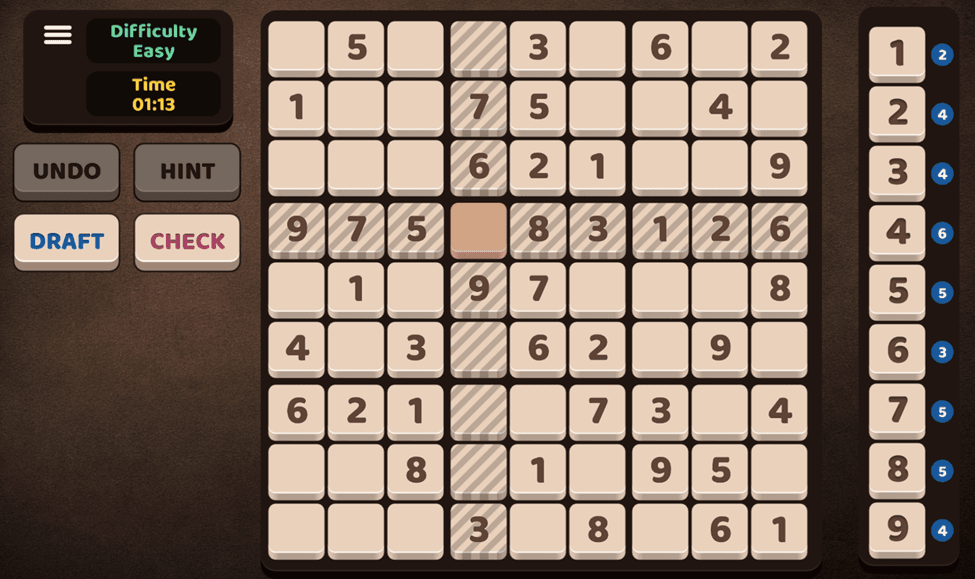
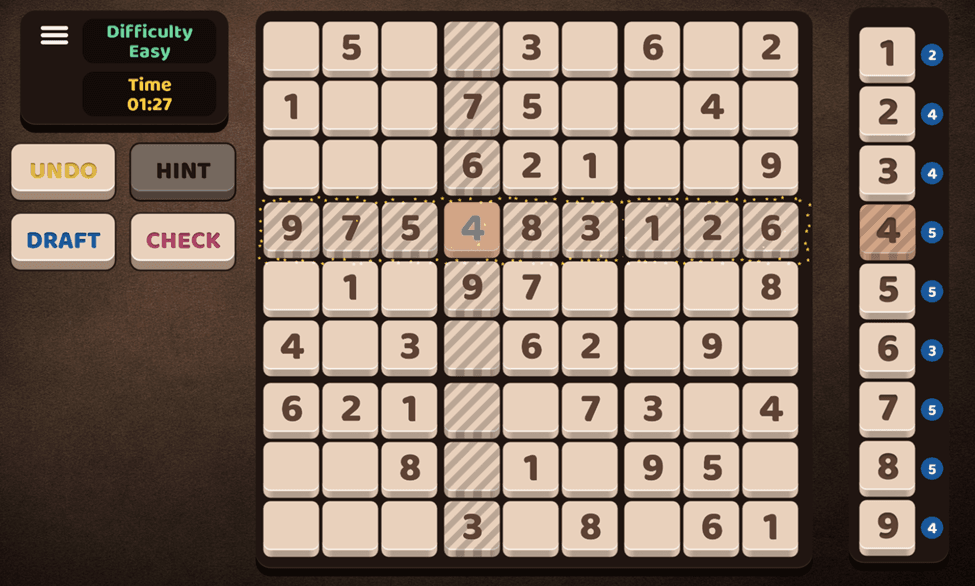
Select one of the numbers on the right to fill in the space. When you enter the correct number and complete a row or column, it will be highlighted for a moment with sparkling stars.
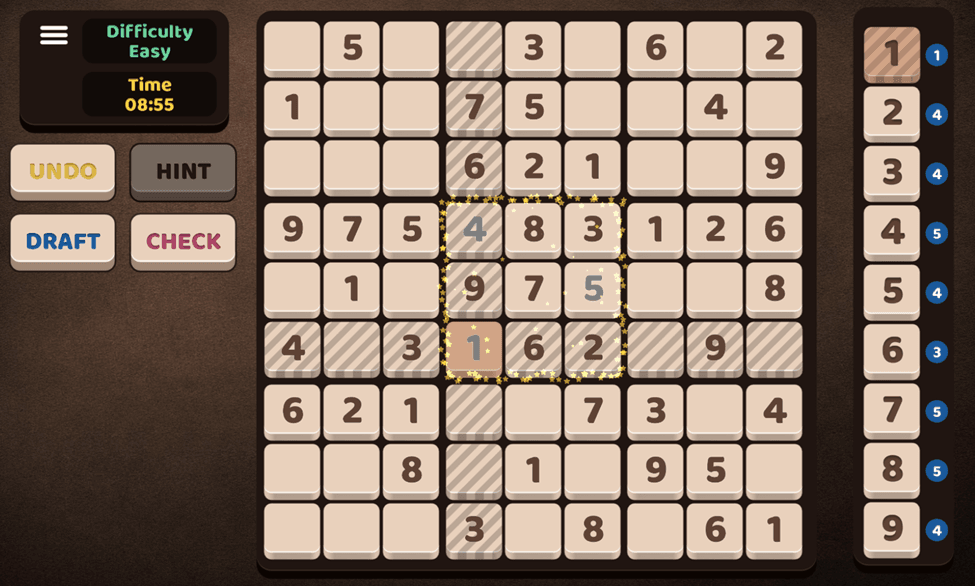
When you complete a 3x3 block it too will be highlighted.
Just make sure that you don’t enter a duplicate number, or it will be highlighted in red, and you won’t be able to complete the row, column, or block.
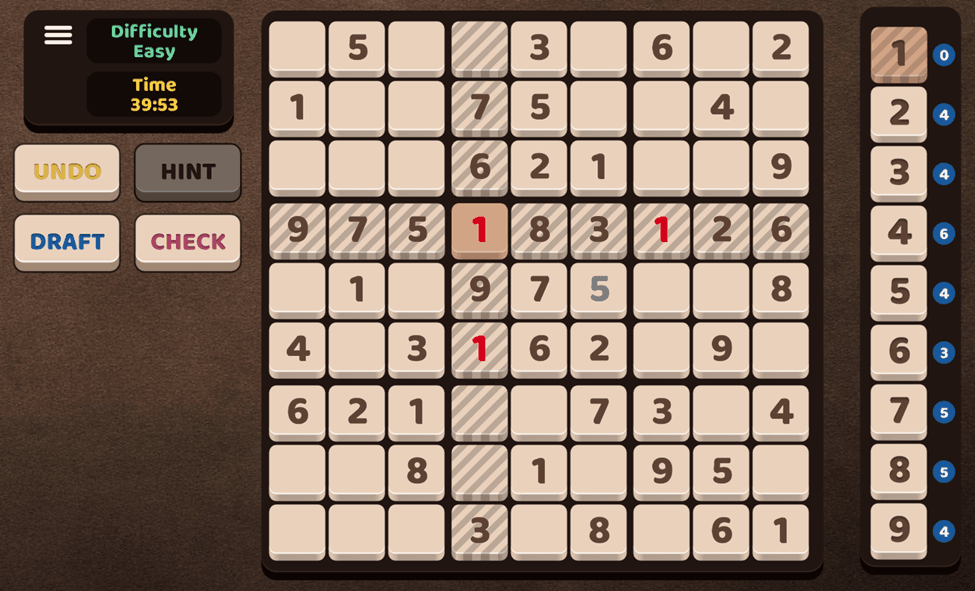
To clear the incorrect number, hit the UNDO button or select it and then click on the same number to the right to clear it. Then try choosing other numbers until you are successful.
For help solving more difficult puzzles, try using "draft mode." Just click the DRAFT button, and then enter numbers into the spaces to apply your predictions.
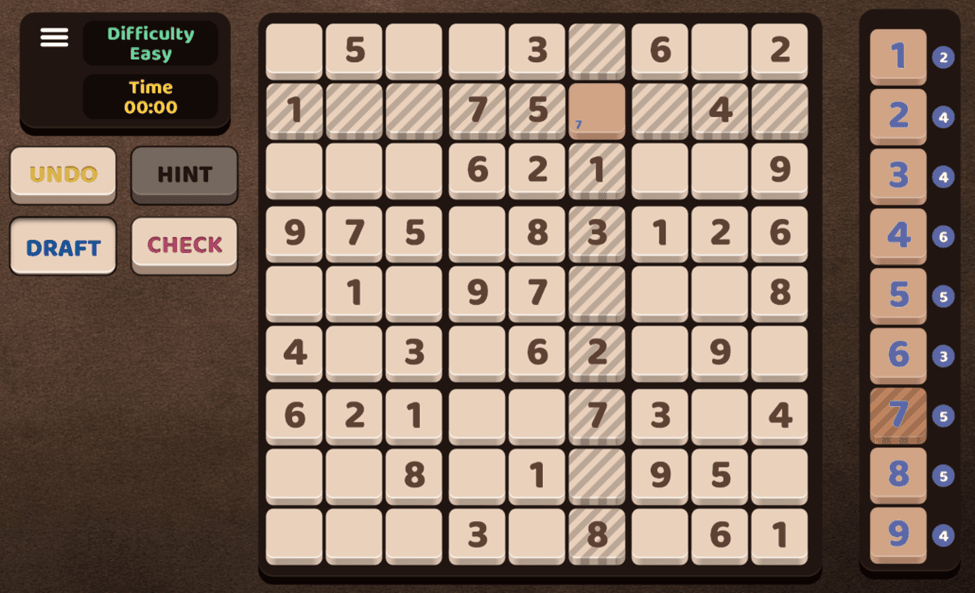
If you get struck, try hitting the HINT button for a suggestion. To see if the numbers you have entered so far could successfully solve the puzzle hit the CHECK button. Now all you have to do is complete the entire board to solve the puzzle.

Good luck and have fun!
How to use the Keyboard controls
If you prefer to use a keyboard, you can use the arrow keys and the W, A, S, and D keys to move around the board. To enter or change a number, press the corresponding number key. To switch to draft mode, press F. To turn it off, press F again. To display a hint, press H. To check if the entered number is correct, press C. To undo entries, press U. At any time, you can also preview the keyboard shortcuts by pressing the Control key.
Sudoku Tips and Strategies
Start with a row, column, or block where most of the boxes are mostly filled in. Typically, at easier levels, there are multiple rows, columns, or blocks where only 3 or 4 digits are missing. Start with those.
First, check which numbers are missing from the row, column, or block. Then, in each blank space, try to check if one of the missing numbers works. If, for example, the number 1 is missing in the row, then check whether it already appears in the column and 3x3 block. This is how you can identify potential places where this number may need to go. Through the process of elimination, you will be able to complete a specific row, column, or block.
Sometimes it happens that in each row, column or block you will not be able to fill the empty spaces by elimination. Then it is forbidden to "shoot". Move to another place where many numbers are already filled in.
Sudoku history
The game of Sudoku as we know it today originated in the late 1970s, however its true origins date back as far as 190 BCE with the creation of the mathematical concept of the "magic square". Chinese mathematicians devised a square array of numbers in which each row, column, and both diagonals sum up to the same number. Here is one of the smallest examples of a magic square.
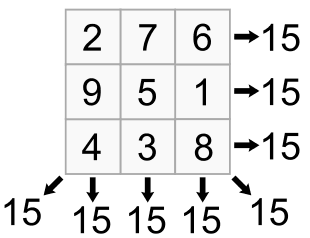
As you can see every row, column, and both diagonals add up to 15. As time went on, other mathematicians in China, India, and Japan built upon this concept to create other puzzles involving grids of numbers with unique properties and constraints to solve for.
The magic square eventually evolved into the "latin square", a concept created by Korean mathematician Choi Seok-joeng. A latin square is a NxN grid of numbers filled with N different types of symbols with the condition that only one of each symbol can appear in each row and in each column. Here is an example of a 3x3 latin square:
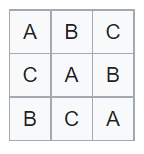
As you can see, each row and column contains only one A, one B, and one C. The latin square was popularized by mathematician Leonhard Euler later in the 18th century. The concepts and theory behind latin squares helped pave the way for the modern version of Sudoku we all know today, but the Sudoku puzzle itself wasn't invented until the 1970s.
An American architect from Indiana named Howard Garns designed the first Sudoku puzzles while working at his architecture firm in Indianapolis in the 60s and 70s. It wasn't until 1979 that "Dell Pencil Puzzles and Word Games", a magazine that had published crosswords and other puzzles since the 1930s, published the first ever Sudoku puzzle, called "Number Place". Although never formally credited with authoring these first Number Place puzzles, Garns was indeed the creator.
The puzzle then spread to Japan, where it was first introduced in 1984 in the paper "Monthly Nikolist" by the Nikoli puzzle company. The puzzle was given the Japanese name "Sūji wa dokushin ni kagiru" which translates to "the digits must be single". The name was eventually shortened to "Sudoku", which is actually a trademarked name in Japan. The generic form of the game is still technically called "Number Place".
Sudoku remained popular mostly in Japan and Asia until 1997 when Wayne Gould, a judge from Hong Kong, began working on a computer program called "Pappocom Sudoku" that would automatically generate solvable Sudoku puzzles. In 2004, Gould convinced The London Times newspaper to publish some of his computer-generated puzzles.
Soon, several other British newspapers added Sudoku puzzles of their own. By the end of 2004, a New Hampshire based newspaper called "The Conway Daily Sun" was the first US paper to publish a Sudoku puzzle. At this point Sudoku had become a worldwide phenomenon, with people of all ages and experience levels taking a crack at solving this unique and storied puzzle.